
Why your IT company’s name could belong to anyone but you
Imagine you have spent years building the reputation of your IT service, only for a disgruntled ex-employee or a patent troll to block your domain or app because you failed to take care of the legal protection of your name in time. In this article, I will explain how proper trademark registration for an IT company transforms a vulnerable name into a protected asset for entering the international market.
Why a name is not just a domain
Many founders mistakenly believe that purchasing a .com domain automatically grants ownership of a brand, yet the legal reality is much stricter. We will break down the critical risks of operating without a trademark and effective methods for securing your name for your business.
Risks of using a name without a trademark

In my practice, outsourced IT companies often face critical threats due to the lack of legal protection for their names. Without official trademark registration, your business becomes vulnerable to competitors who can not only copy your brand but also legally prohibit you from using it in Western markets.
Here are the real risks that turn the lack of a trademark into financial losses:
- Loss of access to marketplaces: A competitor may file an intellectual property infringement complaint with the App Store or Google Play. Without a registration certificate, proving your brand’s priority is extremely difficult, which often leads to the app being blocked.
- “Internal raiding”: Former employees or partners can register your name under their own legal entity. This gives them the right to demand that you stop using the brand or to buy the rights back at an inflated price.
- Blocking corporate channels: The owner of an identical trademark can initiate a UDRP procedure to seize your domain or complain to LinkedIn or Instagram administration, pushing for your official company pages to be banned for “using someone else’s intellectual property.”
- Reputational losses due to “lookalikes”: The appearance of a company with a similar name on the market dilutes your brand. If the “lookalike” provides poor-quality services, this negatively affects your rating and complicates passing compliance checks when signing contracts with Western clients.
Registering a brand is an investment in stability, not just a paper formality. More details on economic feasibility and the calculation of the process costs can be found in our article on the expenses involved in IP protection.
Related article on the topic: Trademark registration for an IT company.
How to secure a brand name for your company
Securing a name for your company is not merely a registration act; it is about building a foundation for your brand’s security. The process begins with a thorough search for analogues in databases, which allows you to identify potential conflicts with other market players at an early stage. Proper trademark registration acts as a legal barrier that prevents former employees or unscrupulous competitors from capitalizing on your reputation.
The intellectual property protection algorithm involves checking the name for uniqueness, selecting NCL (Nice Classification) classes that correspond to the company’s activities, and filing an application to establish a priority date. It is important to account for differences between jurisdictions:
| Criterion | Ukraine (UANIPIO) | USA (USPTO) |
|---|---|---|
| Legal System | Registration-based | Use-based |
| Evidence requirement | Not mandatory | Mandatory demonstration of commercial use |
A common mistake is ignoring intellectual property because you operate on international platforms. For instance, app owners often face cloning of interfaces or icons. Documenting such elements in a certificate is a strategic step for successfully challenging violations in app stores.
Myths about trademarks in IT
- “The name is secured by buying a .com domain.” A domain does not grant legal title to a brand; therefore, the owner of an identical trademark can initiate a UDRP procedure to seize the domain name.
- “Protection is only for large corporations.” Lack of registration makes studios vulnerable to blackmail by third parties who may register the name first to demand royalties.
- “Registration is just a formality.” For investors or Western partners, having a certificate serves as proof of the transparency and maturity of business assets.
Remember that investing in brand protection is more cost-effective than spending resources on rectifying the consequences of losing a domain or litigating for the right to use a name, which you can learn more about in the materials on registration costs.
Ukraine vs. USA: where and how to register
Choosing a jurisdiction to protect your assets depends on the geography of your clients and your plans for scaling services. We will analyze the procedural nuances in Ukraine and the specific requirements of the USA, as well as examine mechanisms for international expansion through the WIPO system.
Key jurisdictional differences
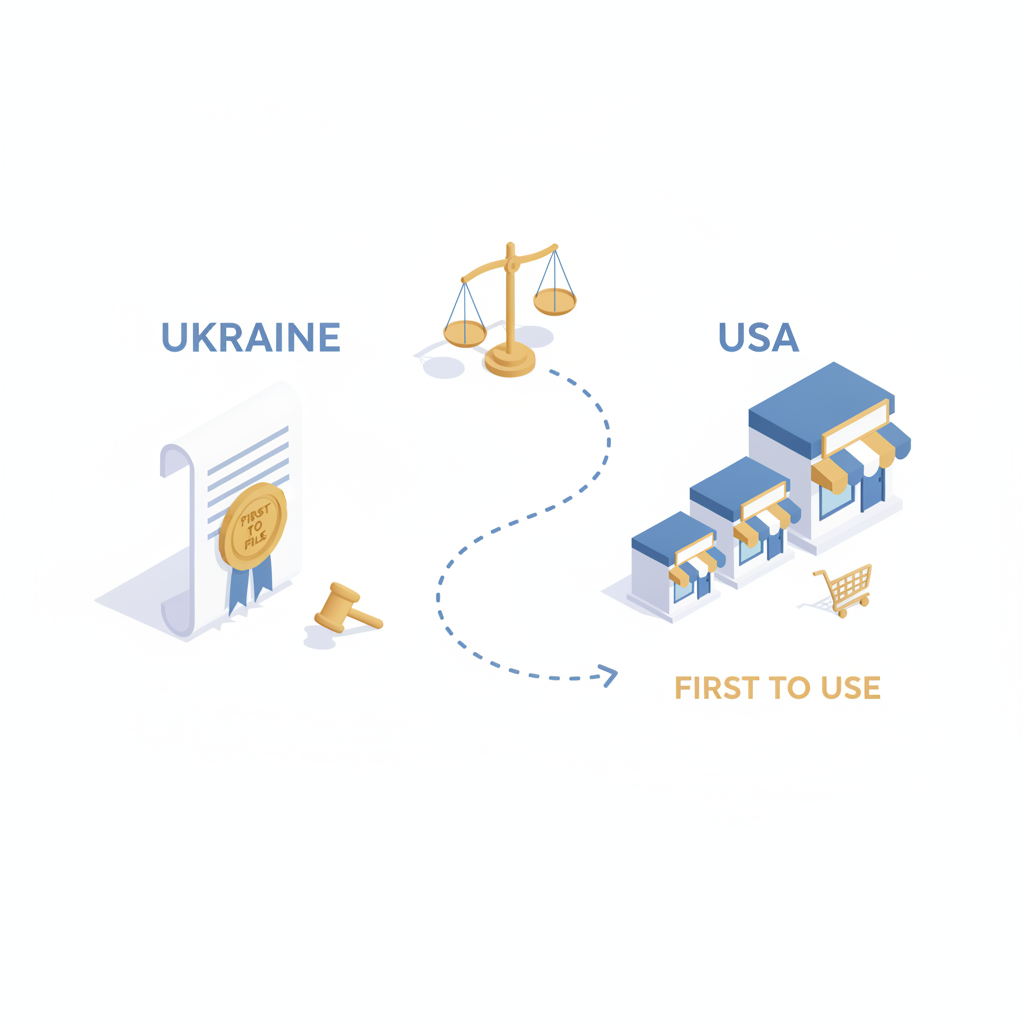
The legal systems of Ukraine and the USA have fundamentally different approaches to the emergence of trademark rights. Ukraine operates under a “first-to-file” system, whereas in the United States, commercial use of the mark is of critical importance. Understanding these differences is key, as without proper protection, your company’s name could be used by bad actors to create identical services.
| Criterion | Ukraine | USA (USPTO) |
|---|---|---|
| Basis for rights | Registration (first-to-file) | Use (business priority) |
| Intent to use | Not mandatory for filing | “Intent to Use” status available |
The American system protects real businesses: you may have some protection under “common law,” but for lawsuits or blocking clones in the App Store, USPTO registration remains the gold standard. In Ukraine, security depends on the applicant’s speed, and you can evaluate the investment required for this process on our resource for analyzing service costs. It is important to remember that even having a certificate does not guarantee success without monitoring, as conflicts can arise even from minor graphic similarities in UX or application names.
Myths about intellectual property protection in IT
- Myth: A .com domain protects a brand worldwide. Reality: A domain is merely a technical address that does not grant exclusive rights to use the name.
- Myth: Protection is only for large corporations. Reality: In service-based IT, the brand itself is an asset that enables scaling and attracting foreign clients.
International Expansion and WIPO
International expansion for an IT business requires an intellectual property protection strategy adapted to the regulations of each specific jurisdiction. There is no single “global patent” in the world, so entering new markets should be viewed as opening new legal fronts. The most rational path for scaling a brand is the Madrid System under the auspices of WIPO, which allows for filing a single application based on a Ukrainian registration to protect a mark in a number of member countries. This optimizes resources, though the final decision on granting legal protection remains with national offices, such as the USPTO or EUIPO.
Brand protection in the USA and Ukraine has fundamental differences that influence the document preparation strategy:
A common mistake is ignoring registration due to the status of a “service company.” In practice, the lack of trademark registration allows unscrupulous former employees to copy the name and business model, leading to a loss of market share. This also applies to mobile solutions: to prevent the appearance of “clones” in the App Store and Google Play, it is necessary to protect not only the name but also graphical elements (icons and UX design) as separate intellectual property objects. At the same time, it is important to understand that having a .com domain name is not equivalent to trademark rights and does not guarantee protection in the event of legal claims from owners of identical brands.
Myths about Trademarks in IT
- Myth about automatic protection: A domain name guarantees the right to a name. Reality: A trademark takes priority over a domain when resolving disputes in arbitration courts.
- Myth about service business: Outsourcing companies do not need a trademark. Reality: A trademark is a legal barrier against “cloning” a brand by former partners or employees.
- Myth about Amazon Brand Registry: Platform protection tools replace registration. Reality: Marketplaces require an official certificate or application number to activate branding features.
Protection of Mobile Solutions and Interfaces
In the IT business, special attention should be paid to mobile products, where the protection of icons and UX elements becomes a key tool for combating clones in the App Store and Google Play through trademark registration mechanisms.
From Icons to UX Elements

In the mobile environment, an app icon is a key visual asset. Developers often rely solely on copyright, but registering a trademark is far more effective for protecting a brand against copying in the App Store or Google Play. While copyright covers only a specific graphic implementation, a protected object provides a monopoly on the visual image within a specific class of services, which significantly simplifies the process of removing clones.
Possessing a certificate becomes a compelling argument for marketplaces when considering intellectual property infringement complaints. To better understand the specifics of protection in different jurisdictions, consider the following comparison table:
Myths about Intellectual Property in IT
- “Protection is only needed by large corporations” — in reality, it saves small businesses from losing their name or identifiers that could be appropriated by a former employee or competitor.
- “Registration does not affect the domain” — on the contrary, owner status is a critical condition for the UDRP procedure, which allows you to reclaim a domain if it has been snatched by cybersquatters.
In practice, holding such rights allows for prompt responses to unfair competition. For example, our client successfully removed a clone of their own application within 48 hours after filing a complaint supported by a certificate number. It is important to remember that the process of obtaining legal protection documents can be lengthy, and the cost varies depending on the number of chosen Nice Classification classes. Such a comprehensive approach minimizes the risks of corporate raiding and strengthens the company’s position in Western markets.
Combating Clones in App Stores
Once the product’s visual identity—from the icon to the UX elements—is established, the next step is protection against copying. The appearance of clones in Google Play or the App Store threatens not only your market share but also your reputation: low-quality software under your brand devalues customer trust. It is important to understand that the absence of registration leaves the company name vulnerable, even to former employees who could register the intellectual property in their own names and block the original application.
To remove clones, app store support teams require legally sound evidence. Unlike copyright, where proving code similarity is a complex and lengthy process, having a certificate for an intellectual property object provides an undeniable legal monopoly. This allows you to initiate a Takedown Notice procedure in a matter of days (for example, removing counterfeit apps with a similar icon often happens within 48 hours after filing a complaint with trademark data). This is why a professional approach to securing rights is the foundation that allows you to use official protection forms in Google and Apple.
When filing a complaint, it is important to provide the certificate number and a link to the official registry. Avoid common mistakes: a .com domain or having a developer account does not replace official legal protection.
Myths About Trademarks in IT
- Myth: A .com domain protects a company name worldwide.
- Reality: A domain name is merely an address on the web. It does not grant a monopoly on the use of the name in commercial activity, unlike a protected trademark.
- Myth: Registering a trademark in Ukraine automatically protects the brand in the USA.
- Reality: Trademarks are territorial. To enter international markets, you must use the Madrid System or file applications directly through the USPTO.
Myths About Trademarks in IT
There are many misconceptions surrounding the legal protection of brands in the technology sector, which often prevent founders from capitalizing on their intangible assets in time. Below, we will break down the most dangerous mistakes and hear practical advice from a lawyer.
Common Founder Mistakes
In the IT environment, there is a false belief that intellectual property is limited only to patent protection for algorithms or code authorship. For a service business, trademark registration is a key asset that builds capitalization and trust. Ignoring this procedure leads to risks where former employees might use the brand name, and developers might lose control over their own UX elements or app icons.
| Myth | Reality |
|---|---|
| Trademarks are only needed by large corporations. | It is an asset that increases company valuation during investments or M&A. |
| A .com domain is legal protection. | A domain is just a technical address; only a trademark certificate gives you the right to prohibit others from using the name. |
| Ukrainian registration protects you everywhere. | Rights are territorial; entering the US or EU market requires an international application (e.g., via the Madrid System). |
Particular attention should be paid to the differences in protection approaches in various markets. In Ukraine, the procedure is based on national legislation, whereas for registration in the USA via the USPTO, it is critical to provide evidence of brand usage (specimens) in actual commercial materials. Understanding these nuances and familiarizing yourself with the cost of registration will help avoid unnecessary expenses and ensure a legal monopoly on your brand at the international level.
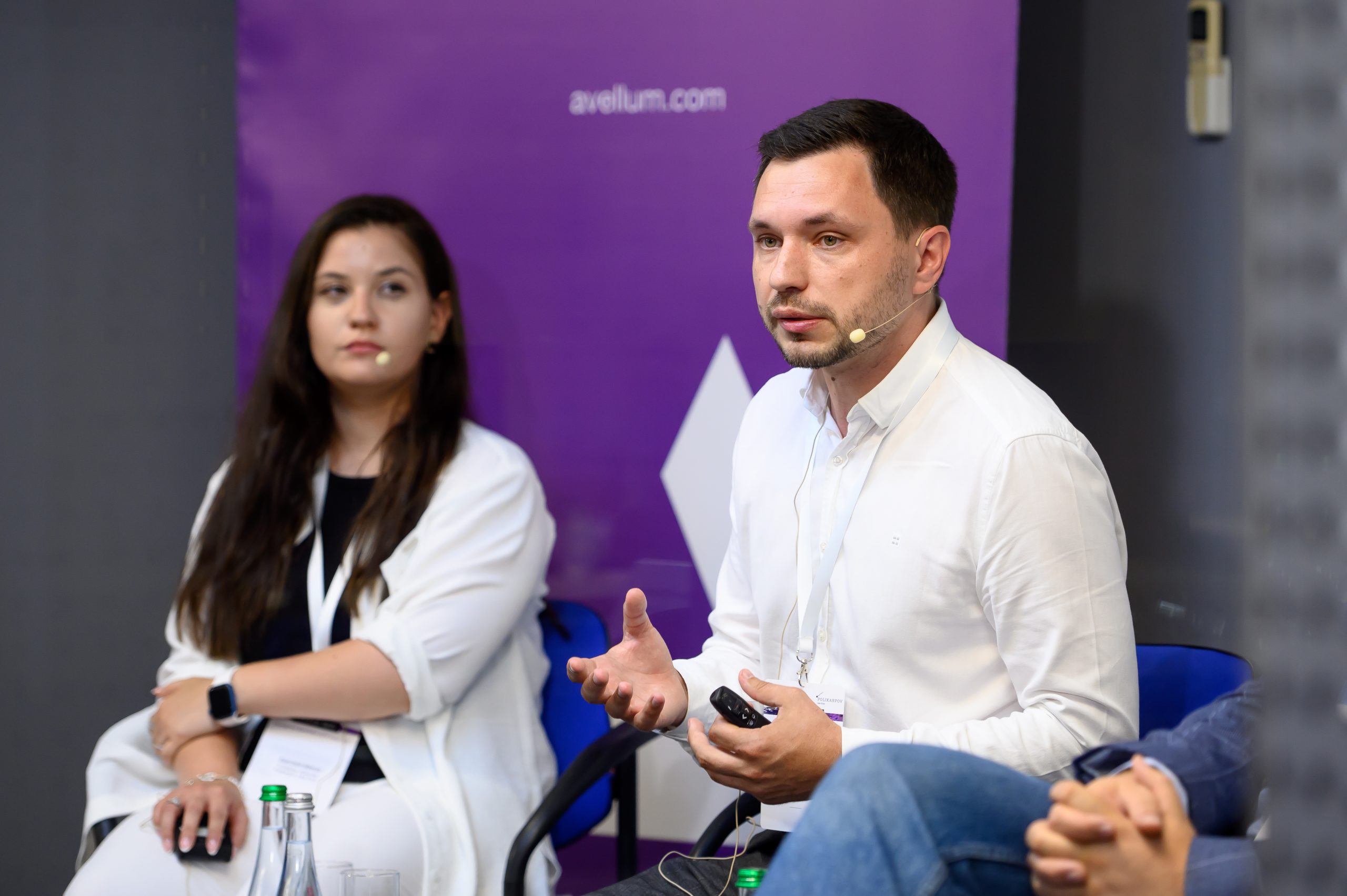
Expert Advice from Anton Polikarpov
Founders are often held back not by a lack of budget, but by the false belief that their code and client base provide sufficient protection. In practice, saving money at the start often leads to a loss of control over the business: former employees may register your name as their own trademark, or competitors could block your brand in search results. This is especially critical for IT service businesses, whose main asset is their reputation.
When scaling to Western markets, brand registration becomes a security tool. If you develop mobile products, having a certificate allows you to promptly remove clones from the App Store or Google Play via the Takedown Notice procedure — this usually takes about 48 hours. This also applies to your product identifiers: unique icons and graphic UX elements. You can learn about the nuances of investing in legal protection in our article on registration costs.
Debunking popular myths: a .com domain does not guarantee rights to a brand — the trademark owner can initiate a UDRP procedure to seize the domain. It is also a mistake to believe that protection is only needed for product companies; for outsourcing firms, it is an investment in client trust.
As a specialist who has repeatedly encountered the consequences of intellectual property piracy, I emphasize: the cost of registration is negligible compared to the loss of your entire brand. Do not view this process as purely legal expenses; it is a fundamental insurance premium for the security of your business.
Before expanding, it is important to understand that this step creates a legal framework within which your company can scale without the risk of “internal raiding” or blocking by competitors.
If you need assistance with this task, please use our Trademark Registration service.
Your brand is not just a name; it is your business
Timely trademark registration for an IT company is not a bureaucratic whim, but a strategic investment that saves massive resources that would otherwise be spent on exhausting litigation or rebranding under pressure from competitors. For service businesses scaling into Western markets, it is essential to implement a comprehensive approach to software protection, securing a legal safety net for every element — from the name to the UX interface. Secure the rights to your intellectual capital today, and read about specific success criteria for SaaS products in our next article.
Frequently Asked Questions
Does copyright protect source code as reliably as a trademark protects a brand?
This is a common misconception. It is important to distinguish between the objects of protection: copyright arises automatically for source code, algorithms, and design, but it only protects the form of expression, not an idea or a brand. This means you can sue for code copying, but proving plagiarism in the IT sector is extremely difficult and expensive.
In contrast, a trademark (TM) protects the name, logo, and identity of your product. If someone releases a product with a name identical to yours, copyright will be powerless, whereas a TM allows you to:
- Legally block the use of similar names by competitors.
- Demand the removal of clone apps from stores.
- Protect the company’s reputation against “parasitizing” your name.
Therefore, copyright is the foundation for protecting content, while a trademark is your legal shield in the market.
How to properly choose Nice Classification (NCL) classes for an IT company to ensure comprehensive protection?
The Nice Classification (NCL) defines the boundaries of your rights. For an IT business, errors in class selection can lead to competitors registering a similar name in related niches.
The main classes typically chosen by IT companies are:
- Class 9: Software, mobile applications, recorded media.
- Class 35: Advertising, business management, business administration (including services for providing business information via the internet).
- Class 42: Software development, SaaS (Software as a Service), hosting, IT consulting.
Important: The selection strategy depends on your business model. If you are purely a service company (outsourcing), the focus should be on Class 42. If you have your own product, you must expand the coverage to protect the entire brand lifecycle. Incorrect class selection renders the registration useless; therefore, before filing, you should review the strategy for protecting software.
Do I need to register a TM separately for each market (USA, EU, Ukraine)?
Yes, intellectual property has a territorial nature. Registering a TM in Ukraine provides protection only within the territory of Ukraine and does not apply, for example, in the USA or EU countries. If you plan to operate in the global market, there are two paths:
- National registration: Filing applications directly with the patent offices of each country (e.g., separately with the USPTO for the USA).
- Madrid System (WIPO): Based on a single base application (e.g., a Ukrainian one) and allows for expanding coverage to over 120 countries worldwide.
This is more convenient and cost-effective; however, it is important to understand that each country has its own legislation and practice. We recommend starting with registration in key target markets where your main clients and competitors are concentrated.
What should I do if the company domain is already taken by someone else?
The fact that a domain is taken does not necessarily mean you cannot use your name. Legally, priority belongs to the TM owner.
If the domain is not in use or is being used for sale (cybersquatting), you can:
- Conduct an audit: check whether the domain owner is infringing on your TM rights.
- UDRP arbitration: use the Uniform Domain-Name Dispute-Resolution Policy procedure to recover the domain through a WIPO body.
- Settlement agreement: sometimes it is cheaper to buy out the domain than to sue, but this is only possible if you have a registered TM.
Without a TM, you have almost no leverage over the domain owner, as a domain name is merely a technical tool, not an intellectual property right.
Why is TM registration mandatory for attracting investment or M&A exit?
For investors and business buyers, a trademark is a key element of IP compliance (Intellectual Property Due Diligence). Having a TM registration certificate confirms that:
- The brand is clean: you are not infringing on others’ rights and will not be a defendant in future lawsuits.
- The company has intangible assets that increase business capitalization.
- The company name is your property, and you will not lose the right to it during the expansion process.
Without a TM, investors perceive the company as a “risky asset” — if someone sues you over the name tomorrow, your business could be shut down. For an investor, this is unacceptable, which is why TM registration is your “ticket” to serious funding rounds.