Why your app might disappear due to cloning
Imagine your startup reaching the top charts, only for an identical clone to suddenly appear in the store, stealing your traffic and revenue. Proper trademark registration for a mobile app is not just a formality; it is your primary tool for quickly removing infringers from the App Store and Google Play.
Brand registration as a prerequisite for release security
Preventive protection of intellectual property is a critical stage in preparing for a launch, as we discussed in detail in our IT strategy guide. Below, we break down why you should reserve your name in advance and the financial risks posed by the lack of a legal shield.
Why the name must be protected

In the legal field, the principle of priority applies: rights belong to whoever first files an application with the National Intellectual Property Office. Launching an app without such registration creates critical risks, as third parties can claim the name, leading to your software being blocked on the App Store or Google Play due to intellectual property infringement complaints.
Brand protection is a preventive investment in the stability of your product. Losing control over it nullifies your ASO and marketing expenses, as you will be unable to effectively fight clones that use your name.
Why it is important to protect more than just the name:
- Figurative TM (Icon): Registering your logo as a graphic object allows you to effectively remove apps that copy your visual style to the point of confusion.
- Complaint Algorithm: Possessing a certificate turns a complex legal dispute into a standard administrative procedure in the developer console, where moderators typically respond within 48 hours.
For a detailed overview of legal mechanisms for protecting assets in IT, we recommend reviewing our main IT Guide. Remember: while an “application filed” status creates a certain legal foundation, the final certificate is the irrefutable argument for marketplaces when removing infringing content.
Related material on the topic: Trademark registration for an IT company.
Risk table without registration
Registering an app name before its release is a strategic move that minimizes the risk of losing control over your intellectual property. Without proper protection, your project remains vulnerable to actions by competitors or “patent trolls.”
| Criterion | Without a TM | With a TM Certificate |
|---|---|---|
| Fighting clones | Difficult: App store support teams often ignore requests without official documentation. | Fast: Administrative removal procedure (usually within 48 hours). |
| Brand protection | Risk of third parties registering the name during early stages. | Guaranteed legal priority. |
| Visual identity | Vulnerability to the copying of graphical user interfaces (GUI). | Ability to block icons that are “confusingly similar.” |
Protecting an icon as a figurative mark is just as important as the name, as visual similarity is the primary tool used to mislead users. If you discover a copy of your product, the action plan is as follows: prepare a complaint via the official IP complaint form provided by the app store, attaching your certificate number. You can find more details on software protection strategies in our software protection guide. To start the registration process, please use our professional assistance.
Icons and interfaces as objects of protection
The visual identity of an app often becomes a target for copying even more frequently than its name. We will examine the specifics of protecting icons as individual objects and the importance of unique interface elements for the security of your UX.
Registering an icon as a figurative TM
As part of a comprehensive interface protection strategy, registering an icon as a separate figurative trademark is a critical step. Competitors often avoid copying the name verbatim, opting instead to create visuals that are confusingly similar to intercept users during searches in the App Store.
This approach provides room for maneuver: you can change the app’s name while keeping the recognizable graphic symbol protected, or vice versa. This creates an additional layer of security, especially during international expansion. For your visual assets to successfully pass examination by the IP office and serve as a reliable tool for fighting clones, they must meet certain criteria.
- Uniqueness and distinctiveness: The image must not be a generic symbol (e.g., a simple shopping cart for an e-commerce app without unique stylization).
- Absence of plagiarism: The icon cannot contain elements from other well-known brands or copyrighted characters.
- Compliance with technical requirements: Submissions must be made in a clear graphic format that reflects all color schemes (if they are part of the protection).
- Correct selection of Nice Classification classes: Protection must extend specifically to software development and related services to carry weight in disputes with app stores.
With a TM certificate in hand, you can block not only identical copies but also any products whose visual style attempts to mislead your audience. This logically leads us to the question of protecting not just a static image, but the entire user experience.
Expert Advice: UX Uniqueness
Protecting your icon is only the first layer of defense. To ensure your product does not fall victim to “confusing similarity,” you should pay attention to the uniqueness of the UX (User Experience) and the graphical interface. When competitors copy not only the logo but also the logic of element placement, color schemes, and specific illustrations within the app, proving infringement becomes more difficult if these objects are not legally secured.
When developing an interface, it is important to avoid standard patterns that are commonly used for a specific category of applications. For example, if you are building a financial service, using only standard “wallet” or “chart” icons without original stylization makes your brand vulnerable. Trademark registration for a mobile application should be accompanied by a check of all visual assets for originality before they are published in app stores. This allows you to create a unique “visual fingerprint” that is easy to defend in disputes against clones.
Expert Advice: In addition to the name and icon, register key interface screens (GUI) as industrial designs or provide evidence of copyright for graphic elements. This will create an additional legal barrier for those attempting to fully copy the “look and feel” of your product. Remember that the legal integrity of the interface is the foundation upon which the brand protection of an IT company is built in the international market.
Proper preparation of visual assets and their legal documentation are critical, as these proofs will form the basis for the next step — actively combating infringers in marketplaces.
Related topic: How to protect an outsourcing IT company brand in Ukraine and globally.
Algorithm for Removing Clone Apps
When third-party developers begin exploiting your product’s unique interface and name, it is time to move from preventive measures to active countermeasures through the official Apple and Google procedures.
In the following sections, we will break down the step-by-step mechanism for filing complaints and provide a real-world case of cleaning a marketplace of pirated copies using a brand certificate.
Step-by-Step Complaint Guide
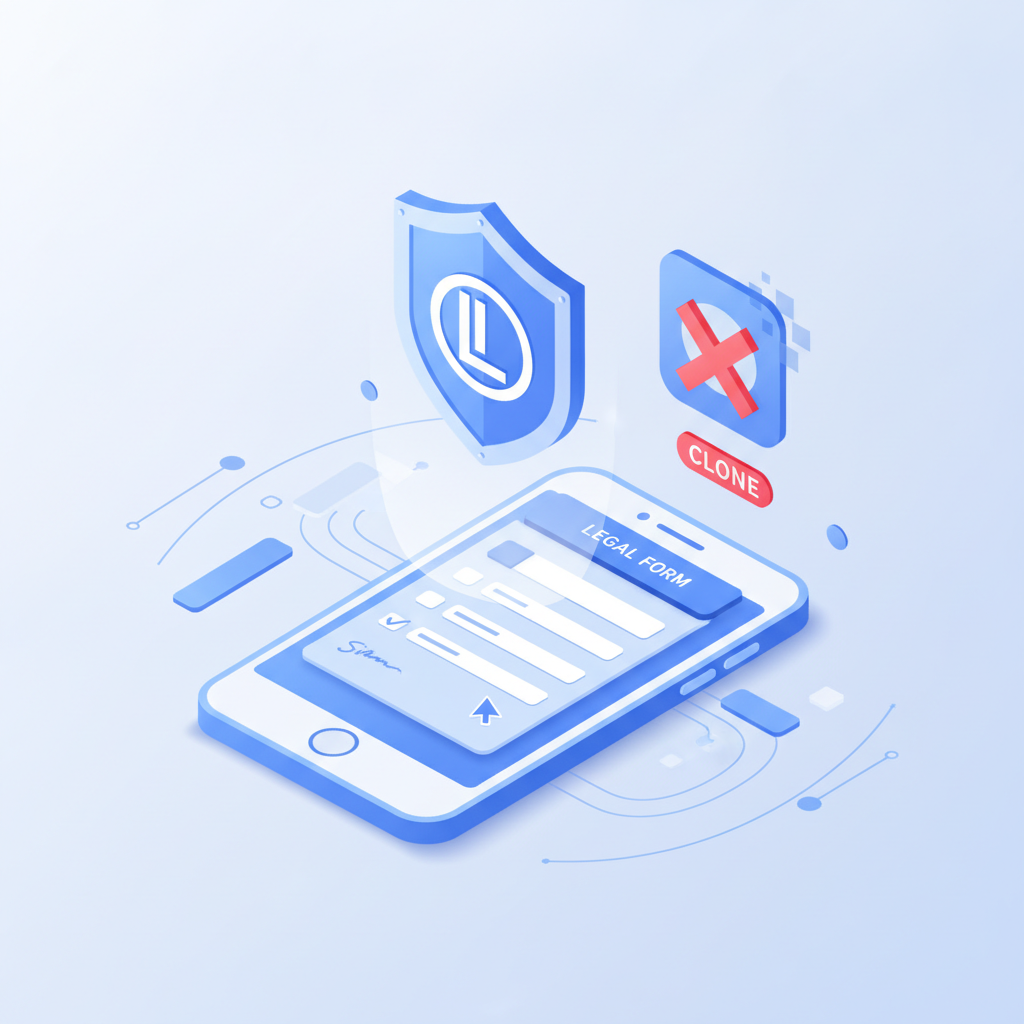
Possessing registered rights allows you to effectively use the internal tools of Apple and Google to block dishonest competitors. Since marketplaces do not act as judicial bodies, they rely on official evidence of IP infringement complaints. To ensure successful protection, the registration of the intellectual property object must precede the release, as legal priority is critical for moderation.
The algorithm for filing a complaint against clone apps begins with building an evidentiary base. You need to prepare digital copies of your certificate and links to the original application, as well as document the facts of infringement through screenshots showing the use of your name, icon, or UX elements. For an icon protected as a figurative trademark, the identification procedure for the infringer is simplified, as visual similarity is sufficient grounds for a claim.
The submission process is carried out through official portals (e.g., Apple App Store Content Dispute or the intellectual property protection tool in the marketplace). In the form, you must select the “Trademark Infringement” category and enter your registration details, including the territory of protection and the certificate number. Note: while filing an application establishes priority, stores usually require the number of an active certificate for guaranteed content removal. A detailed description of how the clone misleads users significantly speeds up the review of your ticket. More information on integrating legal aspects into the technical development cycle is available in our main IT guide.
It is important to consider that the quality and argumentation of the provided evidence directly affect the speed of removing the infringer’s content. The standard response time for stores to justified complaints is usually about 48 hours, although moderators may request additional explanations if the link between your trademark and the disputed object is not obvious.
Case Study: Removing an Infringer from the Marketplace
Once you have a clear understanding of the complaint submission mechanics, it is important to see how these tools work in real-world conditions. Having an official certificate turns a protracted legal dispute into a quick administrative procedure, where marketplaces side with the rights holder in a matter of hours.
Case Study: Blocking a Fintech Service Clone within 48 Hours
One of our clients, a developer of a payment solution, discovered an app on Google Play that completely copied the name and color scheme of their icon. The infringer used similar naming to intercept organic traffic. Since the brand registration had been completed back in the beta-testing stage, we had the current certificate number on hand, which became the decisive argument for moderation.
Instead of going to court, we filed an official IP complaint through the developer console, attaching a digital copy of the document, a comparative table of icons, and a direct link to the infringing app. The platform reviewed the request within two business days, removing the clone app with no possibility of restoration under that name.
The key advantage here is preventive protection. When a marketplace sees a state-issued certificate, it does not engage in discussions about the priority of name usage but instead complies with the requirements of the law. This is why securing intellectual property rights should be completed before your product becomes attractive to “pirates.”
Special attention should be paid to visual elements. Registering a logo as a figurative trademark allows you to block not only identical images but also graphics that are confusingly similar, which is critical for brand protection in crowded App Store and Google Play categories.
Your Next Step in Product Protection
Legal protection is the foundation of your product strategy, not just a formality. Timely registration of your project name before launching an MVP allows you to secure brand rights before the product is even made public, which is critical to preventing patent trolling. If you face copying, having a trademark registration certificate turns the review of a complaint by marketplace technical support into a clear administrative algorithm, often resulting in the removal of the clone within 48 hours.
Algorithm for Protecting Rights in Marketplaces
- Documenting Evidence: Take screenshots of the infringer’s page and their icon that mimics your design.
- Filing a Complaint: Use the IP Infringement Report form on the respective platforms, attaching a copy of your certificate.
- Argumentation: Emphasize the critical similarity not only of the name but also of the visual elements (icons).
We recommend protecting the icon as a figurative trademark, as this allows you to block graphical clones even if the infringer uses a different name. More details on the risks of neglecting registration at the idea stage are described in our IT guide on legal protection for startups. This approach makes copying your product economically unfeasible for unscrupulous competitors.
If you need assistance with this task, please use our Trademark Registration service.
Frequently Asked Questions
Do I need to register a trademark separately for each country where my app is available?
Yes, trademark registration is territorial in nature. A certificate obtained in Ukraine protects your brand only within our state. If you plan to enter the US, EU, or other regional markets, you need to extend your protection.
To optimize this process, there is the Madrid System, which allows you to file a single international application and select a list of countries for protection. This is much more convenient than filing separate applications with the patent offices of each country, although it is important to consider the legal specifics of each market.
Which Nice Classification (NCL) classes are best suited for mobile apps?
Selecting the correct classes from the International Classification of Goods and Services (Nice Classification) is the foundation of a successful registration. For most IT products, the standard set includes:
- Class 9: Covers downloadable software and mobile applications.
- Class 42: Includes services for software development, design, SaaS solutions, and technical support.
Depending on the app’s functionality, additional classes may be required (for example, Class 35 for e-commerce or Class 41 for educational services). A mistake at this stage could leave your protection too narrow to effectively fight off clones.
Will trademark registration help if a clone uses a different name but an identical interface design?
A trademark protects the name, logo, and icon, but it does not always cover the entire UX design. If a clone copies the “look and feel,” trademark registration is only the first step. For comprehensive protection, it is recommended to consider:
- Industrial designs: Registering the appearance of interface elements (GUI) as intellectual property objects.
- Copyright: Source code and graphic elements are protected by copyright from the moment of their creation.
In cases of interface copying, you should seek a legal audit to determine if your property rights to the design have been infringed.
What should I do if I receive a trademark registration refusal due to similarity with another app?
Do not panic — this is a common situation that requires professional analysis. First, you need to check the scope of rights of the competitor and the Nice classes in which they are registered.
Potential solutions include:
- Arguing the absence of “confusing similarity” (e.g., different target audiences, different niches).
- Entering into a Coexistence Agreement with the owner of the other trademark.
- Adjusting the list of goods and services to exclude conflict zones.
Before filing, it is important to conduct a preliminary search to minimize such risks before the official procedure even begins.
Is copyright alone enough to protect an icon, or is it mandatory to register it as a trademark?
Although design objects automatically fall under copyright, trademark registration provides you with a unique tool for influence over the App Store and Google Play administration. Stores respond much faster and more effectively to complaints (DMCA takedowns) when you provide a trademark certificate number rather than making abstract claims about copyright infringement.
Registering an icon as a trademark turns your graphic element into an asset that is easier to protect in both judicial and pre-trial proceedings, as the certificate serves as irrefutable evidence of your exclusive rights to the mark.