

Introduction: Why Nice Classification classes define the future of your brand
International Nice Classification classes for a trademark define the legal boundaries of your business, beyond which the name remains unprotected from encroachment by competitors. A mistake in compiling this list creates a dangerous “loophole” that allows other players to legally capitalize on your reputation in related niches.
What is the Nice Classification and how does it work
The Nice Classification of goods and services acts as a detailed “geographical map” of the commercial space, where each of the 45 sectors marks a specific territory for the monopolization of a name or logo. We will analyze the structure of these categories in detail and explain why the “capture everything” strategy usually becomes a financial trap for a brand owner.
45 Classes: Understanding the Structure
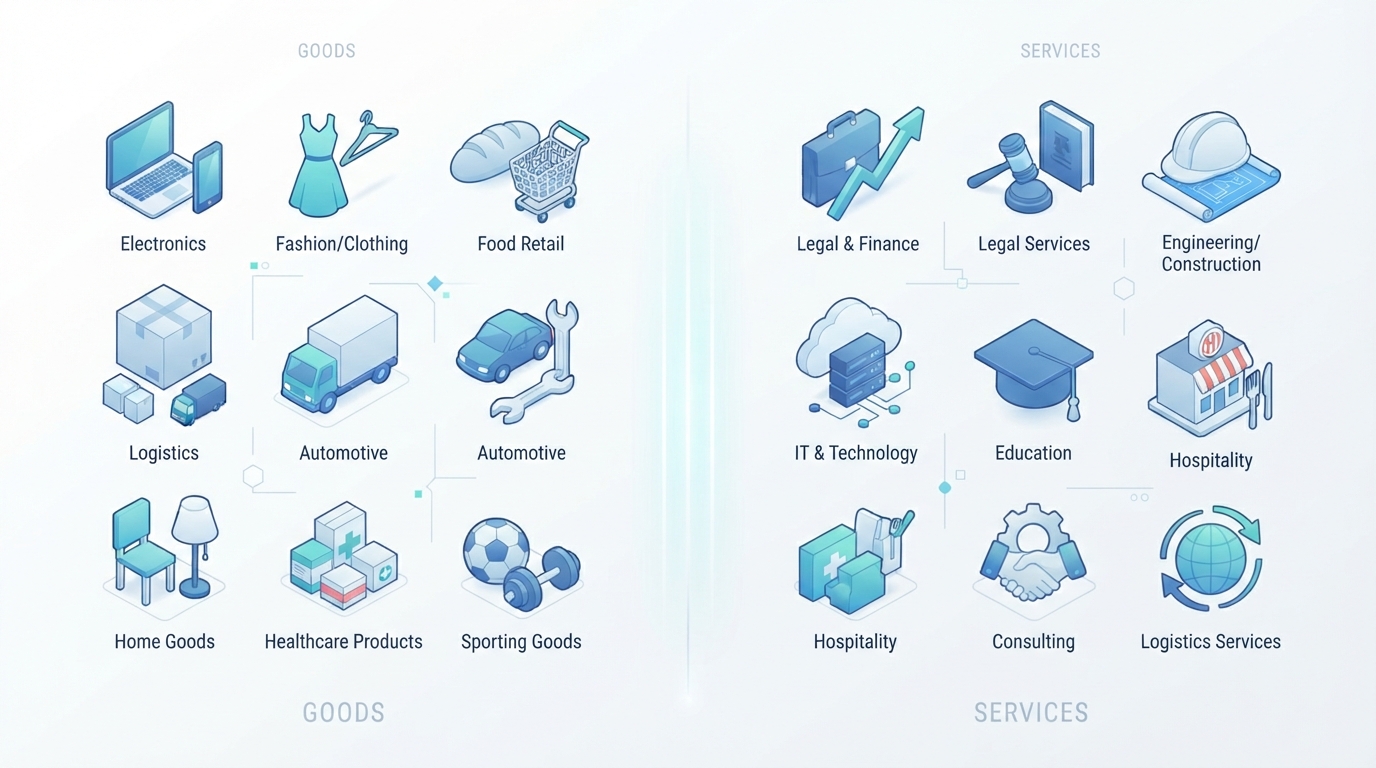
The Nice Classification system is not just a bureaucratic list, but a clearly structured catalog that divides the entire global market into 45 autonomous zones. The first 34 classes cover tangible goods—from chemicals and electronics to clothing and food products. The remaining 11 classes (from 35 to 45) are designated for services, such as advertising, insurance, education, or legal support. This division allows for the identification of a business within the legal framework, distinguishing a software developer from a coffee shop owner, even if their names are identical.
It is important to understand that every selected item directly affects the financial burden during registration. Since the government fee is paid for each individual category, thoughtless expansion of the list only increases costs without any real benefit. For example, if your business is focused on creating content for blogs, it is critically important to protect your copyrights through the appropriate service classes, rather than claiming the production of industrial equipment. The difference between a brand and a commercial name lies precisely in the fact that a trademark protects only those areas that you have declared in your application.
| Class Group | Range | What it covers (examples) |
|---|---|---|
| Goods | 01 – 34 | Cosmetics, gadgets, furniture, textiles, beverages. |
| Services | 35 – 45 | Marketing, IT development, hospitality, medicine. |
Competent combination of positions allows you to create a reliable legal shield without wasting extra budget on areas that will never intersect with your activities. However, the desire to maximize the “bloating” of an application often leads to the opposite effect, creating risks for the cancellation of protection in the future.
Why you shouldn’t choose ‘everything at once’
The desire for “total” protection often pushes entrepreneurs to register their brand in dozens of categories simultaneously. However, the strategy of accumulating classes “just in case” carries financial risks and creates legal vulnerabilities.
By choosing unnecessary Nice Classification (NCL) classes, you risk facing the early termination of your certificate due to non-use. According to Article 18 of the Law of Ukraine “On the Protection of Rights to Marks for Goods and Services,” if a mark is not used for certain goods or services within five years from the date of publication of the certificate issuance, any interested party may initiate the cancellation of protection for those specific items through the court.
Risks of excessive coverage:
- Legal vulnerability: The presence of “dead” classes where the business does not operate turns your certificate into a target: competitors can demand the cancellation of protection specifically in those categories to clear the way for their own registrations.
- Preliminary refusals: Increasing the list of classes raises the probability of conflict with already registered marks in related niches, which forces the IP Office of Ukraine (UkrNOIVI) to issue preliminary refusals.
- Budget inefficiency: The cost of the procedure depends directly on the number of selected classes; filling an application with categories unrelated to your business leads to wasted government fees.
To form a protection strategy, it is advisable to use an activity correspondence matrix:
| Selection Category | Recommended Strategy |
|---|---|
| Current activity | Mandatory registration |
| Plans for 2–3 years | Advisable registration (strategic development) |
| “Just in case” | Not recommended (non-use risk) |
In practice, professional support for the registration procedure involves selecting a “core” of classes that truly secure a monopoly on your product or service. Avoid requests in “foreign” areas (for example, if you are an IT company, registration in class 25 for clothing without the intention of producing it is redundant). Always evaluate the current state of your portfolio and business needs before submitting a new application.
The Impact of Classes on the Scope of Brand Protection
Properly selected categories define the boundaries of your market monopoly, turning a name into a true commercial asset. In the following sections, we will examine specific examples of how classes shape the scope of rights and where the most dangerous “gaps” in legal protection arise.
Table: How Classes Form a Monopoly
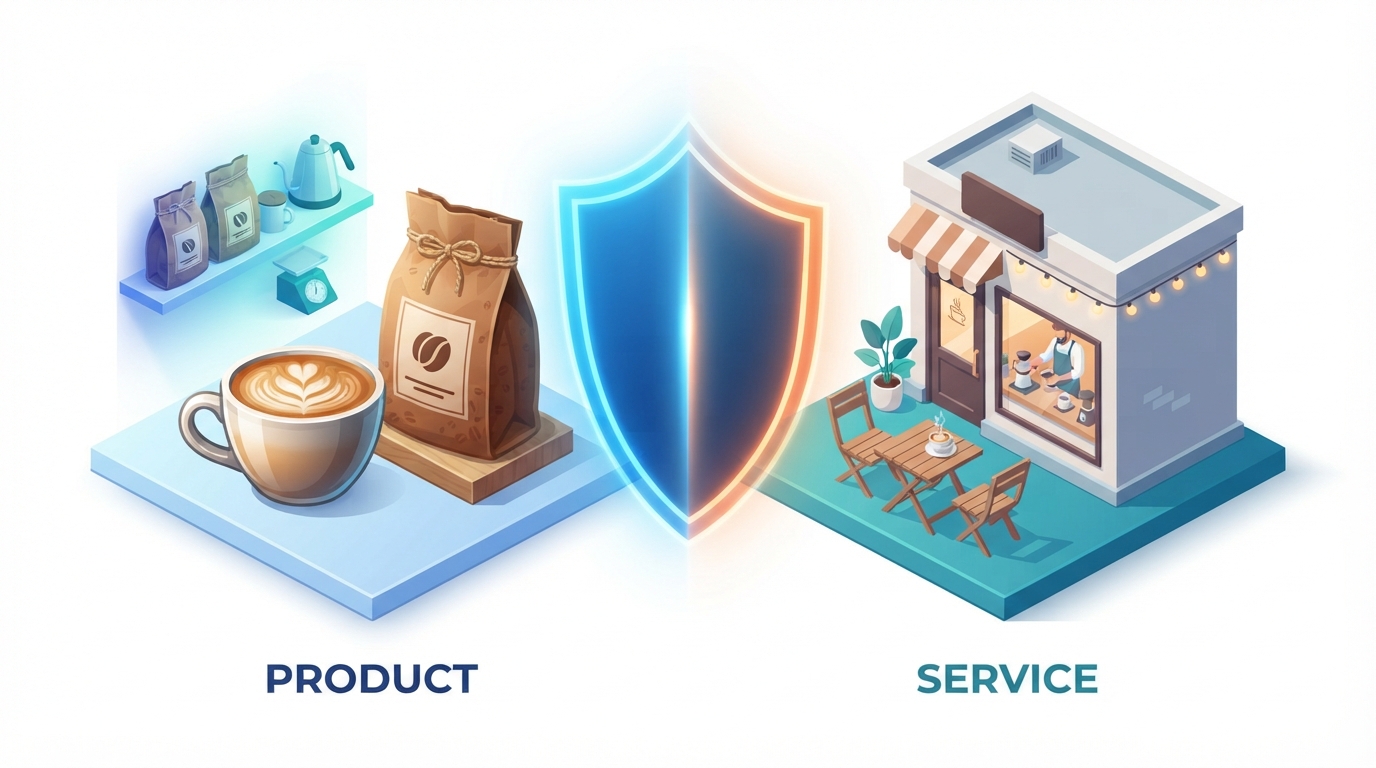
The scope of rights granted by a certificate is not limitless: it is restricted to the list of goods and services selected during registration (remember that once an application is submitted, it is impossible to expand this list or add new classes). To understand how this boundary works, it is worth comparing protection across different, at first glance similar, categories.
Confusion often arises between selling a product and manufacturing it. For example, if you plan to open a food establishment, it is not enough to register the name only for food products — it is essential to protect the service aspect as well. This is a fundamental difference between a brand as a marketing concept and a trademark as a legal instrument: the name of a beverage does not protect the name of a coffee shop.
| Class | What is protected (examples) | What is not covered by protection |
|---|---|---|
| Class 30 | Coffee, tea, cocoa, confectionery products directly. | Services of coffee shops, restaurants, food delivery (this is Class 43). |
| Class 35 | Advertising, business management, retail trade (shops). | Manufacturing of goods sold in the store (e.g., clothing manufacturing is Class 25). |
| Class 41 | Education, entertainment services, training, book publishing. | Software for online learning (this is Class 9). |
This table demonstrates the autonomy of categories: protection in Class 30 allows you to prevent others from using your name on coffee packaging, but it will not help against a competitor who opens a cafe with the same name without registration in Class 43. It is in such nuances that the greatest risks to business security usually lie.
Such a division creates conditions for situations where a brand owner feels protected, even though, in reality, their main asset remains open to attacks.
Related material on the topic: The difference between a brand and a trademark.
The Risk of ‘Gaps’ in Legal Protection
Businesses often view registration as a one-time action, yet commercial activity is a dynamic process. Legal documentation that remains static over time creates gaps: if you add ancillary services, your old Nice Classification (NCL) classes may not cover the actual scope of your operations. According to the Law of Ukraine “On the Protection of Rights to Trademarks for Goods and Services,” the scope of legal protection is strictly limited to the list submitted in the application. This creates “gaps” through which competitors can register similar designations in adjacent niches.
It is important to remember that you cannot simply add new items to an already issued certificate. Any expansion of activity requires a new procedure—from filing an application to examination—so for a scaling business, updating your portfolio should become a regular strategic task. For example, a software developer entering the retail market with their own branded merchandise needs protection in new classes; otherwise, exclusive rights to the brand will not extend to those goods.
If you see that your current level of protection does not match market realities, it is advisable to take timely care of securing new areas of activity.
| Scenario | Legal Vulnerability |
|---|---|
| Model change (services → goods) | Lack of rights to sell products |
| Launching own merchandise | Risk of logo copying on clothing/stationery |
| Entering franchising | Insufficient protection in Class 35 (administration) |
| Online retail | Lack of name protection in the digital space |
Disclaimer: This material is for informational purposes only and does not constitute individual legal advice. The scope of rights always depends on the specifics of a particular registration and the prior rights of third parties.
Common mistakes when choosing classes
Even experienced entrepreneurs make fatal mistakes when choosing categories, which leads to registration rejections or the loss of rights in court. We will break down a practical checklist for verifying your application and provide advice on strategic planning for the future.
Checklist: Reviewing your application

Preparing documents for brand registration on your own often feels like a lottery, where errors in Nice classification can be critical. Instead of a formal list, focus on the strategic alignment of your data with the official WIPO classifier. First and foremost, verify whether the selected classes cover the goods and services that generate your business’s primary revenue, as this specific list defines the boundaries of your legal monopoly.
When analyzing your application, critically evaluate the “realism” of the chosen classes: registering “for future growth” in niches where you do not plan to operate within the next 2–3 years creates a risk of cancellation due to non-use. At the same time, do not ignore related areas, such as Class 35 for online retail, if your business model involves scaling. If you are unsure about distinguishing between goods and services, professional support during the registration process will help avoid conflicts with similar marks that could lead to a refusal by the IP office.
It is important to remember that the scope of protection is legally limited to the exact list recorded in the certificate. Therefore, the accuracy of the terms and their compliance with the current version of the classifier is the key to ensuring your intellectual asset can withstand future legal challenges from competitors.
Expert Advice: Look to the Future
Business is a dynamic system, so a static approach to intellectual property often leads to a loss of market position. When we work on a protection strategy, it is important to consider not only current operations but also scaling plans for the coming years. Failure to register in related categories creates “legal loopholes” that competitors can exploit.
The fact is that choosing categories under the International Classification of Goods and Services (Nice Classification) is a tool for strategic planning, not a bureaucratic formality. It is impossible to add new classes to an already filed application — the law only allows for narrowing the list. To expand the list of goods or services, you will have to initiate a new procedure, pay fees again, and wait for the result while your rights in new niches remain unprotected. To avoid such risks, optimal trademark registration should account for both primary revenue streams and related areas.
My advice: build a certain “margin of safety” into your application. Focus on categories that will become the foundation of your business in the future. For example, for IT startups, it is often critical to combine Class 9 (software) with Class 42 (cloud services and development), as the line between a product and a service in modern practice is quite arbitrary. This approach helps protect the brand from common mistakes where the owner becomes a hostage to cost-cutting at the initial stages.
Remember: according to WIPO rules, rights to an intellectual property object are limited only to the goods and services for which it is registered. Therefore, legal security is not a one-time act, but a continuous process of supporting your scaling.
Protection Strategy: How to Account for Scaling
An effective intellectual property protection strategy requires businesses to be able to forecast market development and timely expand the scope of legal protection for their brand. In the following sections, we will analyze in detail a hypothetical case of transforming a local project into a large network and identify specific markers that indicate the need to register new categories of goods and services.
Hypothetical Case: From Coffee Shop to Franchise
Analysis of business dynamics demonstrates that the legal framework must evolve in parallel with operational activities. The evolution from a local establishment to a chain is the most illustrative example of legal risks. At the start, it is sufficient to protect the brand in Class 43 (food services), but scaling requires a review of the strategy.
Transformation: From Coffee Shop to Franchise Business
Let’s look at the path of our client, who required portfolio adaptation at different stages of growth:
- Product: Launching packaged coffee requires registration in Class 30. Without this, you cannot prevent competitors from selling beans under your name in retail.
- Merch and Loyalty: The introduction of branded accessories (mugs, textiles) requires protection in Classes 21 and 25 to avoid parasitic use of your reputation.
- Scaling: Transitioning to a franchise requires attention to Class 35 (business management), which allows for the legal transfer of rights to the business model to partners.
Each step is about creating a market monopoly, where correctly selected trademark registration categories serve as the foundation for security. According to the Nice Classification, ignoring related niches allows competitors to use your brand recognition in areas you assumed were “yours” by default. Such phased expansion helps to clearly delineate spheres of influence without overloading the budget at the start, while minimizing the risks of rights cancellation due to non-use in the future.
When to expand classes
Business never stands still, and what was a local service yesterday can turn into a large-scale ecosystem today. It is important to identify the moment when your company outgrows its initial legal framework before your competitors take advantage of it. If you notice that your brand name is starting to appear on products you haven’t produced before, or in services you are only planning to launch, this is a direct signal to take action.
Determining the feasibility of expanding your list of goods and services is based on analyzing touchpoints with the customer. We identify three key markers when additional registration becomes a critical necessity for the stability of your intellectual property:
- Change in business model: for example, transitioning from providing consultations to selling proprietary courses or software tools requires protection in categories related to education and digital media.
- Launch of merchandise and related products: brand popularity often prompts the release of clothing, accessories, or stationery, which requires coverage in completely different categories than your core business.
- Entering the franchising market: transferring the rights to use a brand to third parties requires impeccable protection in the class that regulates business management and commercial mediation.
It is important to understand that the law does not allow you to simply “add” new items to an already issued certificate. Each expansion is effectively a new cycle of interaction with government agencies, involving the submission of a separate application and undergoing a full examination procedure. Therefore, a strategic review of your trademark portfolio should be conducted annually so as not to leave legal loopholes for patent trolls.
Understanding these criteria allows you to transform registration processes from a bureaucratic obligation into a tool for business capitalization. A properly formed list becomes the foundation upon which further legal security and market advantage are built.
If you need help with this task, take advantage of our offer for Trademark Registration.
Conclusion: Your rights begin with the right list
Correctly selected Nice Classification classes for a trademark turn a registration certificate from a formal piece of paper into a powerful legal weapon that provides a real monopoly in the market and protects the business from competitors’ claims. Since it is impossible to expand the list of categories in an already issued document, strategic planning of the list of goods and services is a critical stage that requires a deep understanding of not only current legislation but also the logic of your company’s future scaling. To avoid the risks of protection cancellation due to non-use or the emergence of legal “loopholes,” it is worth clearly understanding the difference between a marketing brand concept and the legal status of a trademark. If you strive to obtain reliable protection without classification errors, contact our team’s specialists to develop an individual registration strategy.
Frequently Asked Questions
Is it possible to change the list of Nice Classification classes after submitting a registration application?
According to IP office rules and international practice, you cannot significantly expand the list of goods or services once an application has been submitted. If you have submitted an application and subsequently realized that you forgot an important class, the procedure is as follows:
- You can file a new, separate application for the additional classes. This will be treated as an entirely new procedure with its own examination period and separate fees.
- In some cases, narrowing the list (removing unnecessary items) is permitted, but adding new types of activities is not.
That is why the preliminary search and strategic planning stage is critical, as it is impossible to “add” classes to an existing certificate after the application has been submitted.
Does registering a trademark in specific classes protect a brand name on the internet, for example, in domain names?
Registering a trademark grants you the exclusive right to use the designation in business activities within the registered classes, but it does not automatically grant the right to own a domain name. These are separate legal domains.
However, a trademark certificate is a significant legal argument for:
- Resolving domain name disputes through the UDRP (Uniform Domain-Name Dispute-Resolution Policy) procedure.
- Filing complaints with platforms (e.g., Google, Facebook, Instagram) regarding the unauthorized use of your brand in advertisements or profiles by other parties.
Trademark registration significantly simplifies the process of “reclaiming” a domain if third parties are using your name in bad faith.
What is the difference between a trademark and a trade name, and is it necessary to register both?
This is a common point of confusion. A trade name (the company name in the Unified State Register) is a way of identifying a business as a legal entity. Its protection is limited and applies only within a specific territory and scope of activity.
A trademark (TM) is an asset that:
- Has territorial protection (in Ukraine or abroad).
- Provides a monopoly specifically for certain goods or services defined by Nice Classification classes.
- Can be sold, licensed, or contributed to authorized capital.
We recommend registering a trademark, as an entry in the register of legal entities does not prevent competitors from using an identical name for goods or services in their own business activities.
What exactly cannot be registered as a trademark?
In accordance with Article 6 of the Law of Ukraine “On the Protection of Rights to Marks for Goods and Services”, there are clear restrictions. You will not be able to register a designation if it:
- Lacks distinctiveness (for example, generic words like “milk” for selling milk).
- Is deceptive (misleads the consumer regarding quality or origin).
- Contradicts public order or generally accepted moral principles.
- Is a reproduction of state symbols, official names of states, or international organizations without appropriate authorization.
Also, names that are already identical or confusingly similar to previously registered marks in identical or related Nice Classification (NCL) classes are not eligible for registration.
Why do businesses sometimes refuse to register a trademark, and what are the risks of such a decision?
Some entrepreneurs believe that simply registering a sole proprietorship or an LLC with the corresponding name is enough. This is a critical mistake. The main risks of not registering a trademark include:
- Loss of brand: A competitor can register your name for themselves, after which you will be forced to change your signage, domain, and entire identity.
- Legal vulnerability: Without a certificate, you have almost no way to take action against other market players copying your logo or name.
- Inability to scale: Franchising or entering international markets (via the Madrid System) requires official registration in the country of origin.
Trademark registration is an investment in the capitalization of your business, creating a protected intangible asset.