
Why your Lviv pub’s name is more than just a sign—it’s a legal asset
Every new pub risks closing due to a lawsuit if its name hasn’t been pre-vetted by lawyers. We will explore how trademark registration in Lviv for food projects is properly prepared to safeguard a name from being copied by competitors.
Preliminary search as the foundation of successful trademark registration
An establishment’s legal security begins with a registry analysis to identify potential conflicts. Next, we will look at the difference between identical names and similar marks, as well as the hazards of DIY checks through standard search engines.
The difference between identity and likelihood of confusion
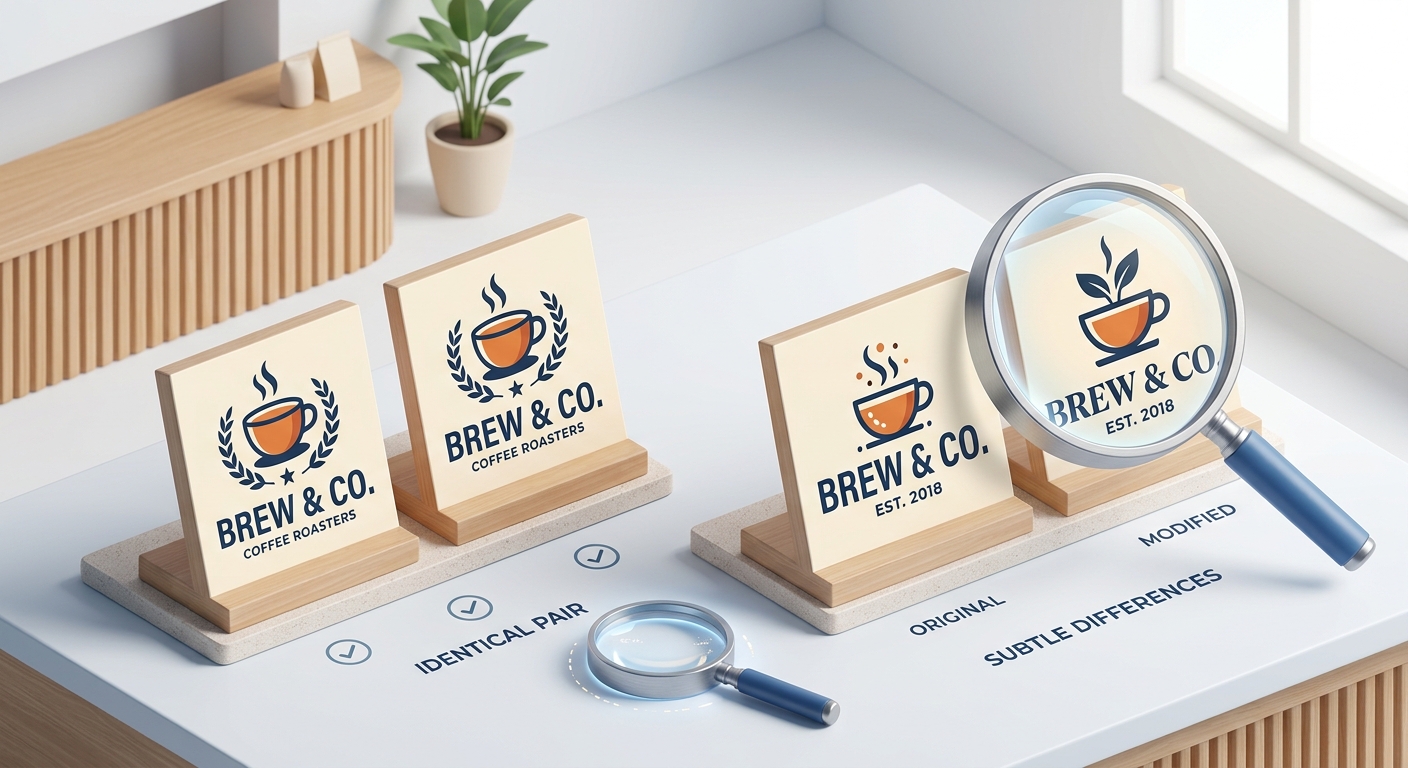
In legal terms, identity is a complete match, easily identified even without specialized training. However, most UANIPIO refusals concern “likelihood of confusion,” where names sound or look different but evoke the same associations for the consumer. For instance, if a competitor is already using a similar brand, you won’t be able to monopolize the market without proper trademark rights, even if the names differ by only one letter.
Our experts often encounter HoReCa situations where owners choose names like “Lviv Coffee” or “Galician Cuisine.” Beyond descriptiveness, there is a risk of conflict with dozens of existing marks. It is important to understand that the examination assesses three criteria of similarity: visual (how the logo looks), phonetic (how the name sounds), and semantic (the meaning it conveys). To avoid errors, it is worth studying the specifics of protecting local brands if you plan to scale a gastro-project beyond the region.
We analyze these risks using professional databases, taking into account not only registered marks but also pending applications that hold priority. This allows for naming adjustments right at the start to avoid future litigation and the costs of rebranding. Now, let’s explore why searching only on Google is a direct path to receiving a court summons.
Why Searching Only on Google is a Path to a Legal Summons
Google is a marketing tool, not a legal one. When a restaurateur or food startup enters a name into the search bar, they only see those who are already actively promoting online. However, international registrations under the Madrid System that have recently extended their protection to Ukraine, and thousands of applications currently at the examination stage, remain outside the reach of algorithms. These “invisible” objects have legal priority: even if your brand was the first to become famous in Lviv, an earlier application filed from any other city gives the opponent the right to block your activities through the court.
Comprehensive trademark registration includes an analysis of not only identical names but also conflicts in related Nice classes. For example, a search engine might not provide information about a manufacturer of sauces or frozen convenience foods (Class 30), whose name will become an insurmountable obstacle to registering a cafe name (Class 43) due to the similarity of services. Professional legal clearance reveals such “pitfalls” before funds are invested in menu design and POS materials.
For businesses in the western region, the issue of territorial competition is particularly acute. A local project can safely exist for years until the owner of a similar TM from another region decides to scale a franchise or send a claim of infringement. For those considering growth, brand protection with an eye on export is the only way to legally secure a name across the entire country, preventing unexpected legal summons from rights holders who simply weren’t in the Google search results.
This aspect is covered in more detail in a separate article Trademark Registration in Lviv: Brand Protection for Export and IT.
This aspect is covered in more detail in a separate article TM for IT Startups: This Option and Software Protection.
Gastronomic Nice Classes: Where Risks Hide for Food Brands
Choosing the correct Nice classes determines the legal boundaries of your protection. We will examine conflicts between product groups and coffee shop services, as well as the protection of a restaurateur’s assets—from merch to franchises.
Cross-Classes: When a Coffee Brand Conflicts with a Coffee Shop Name
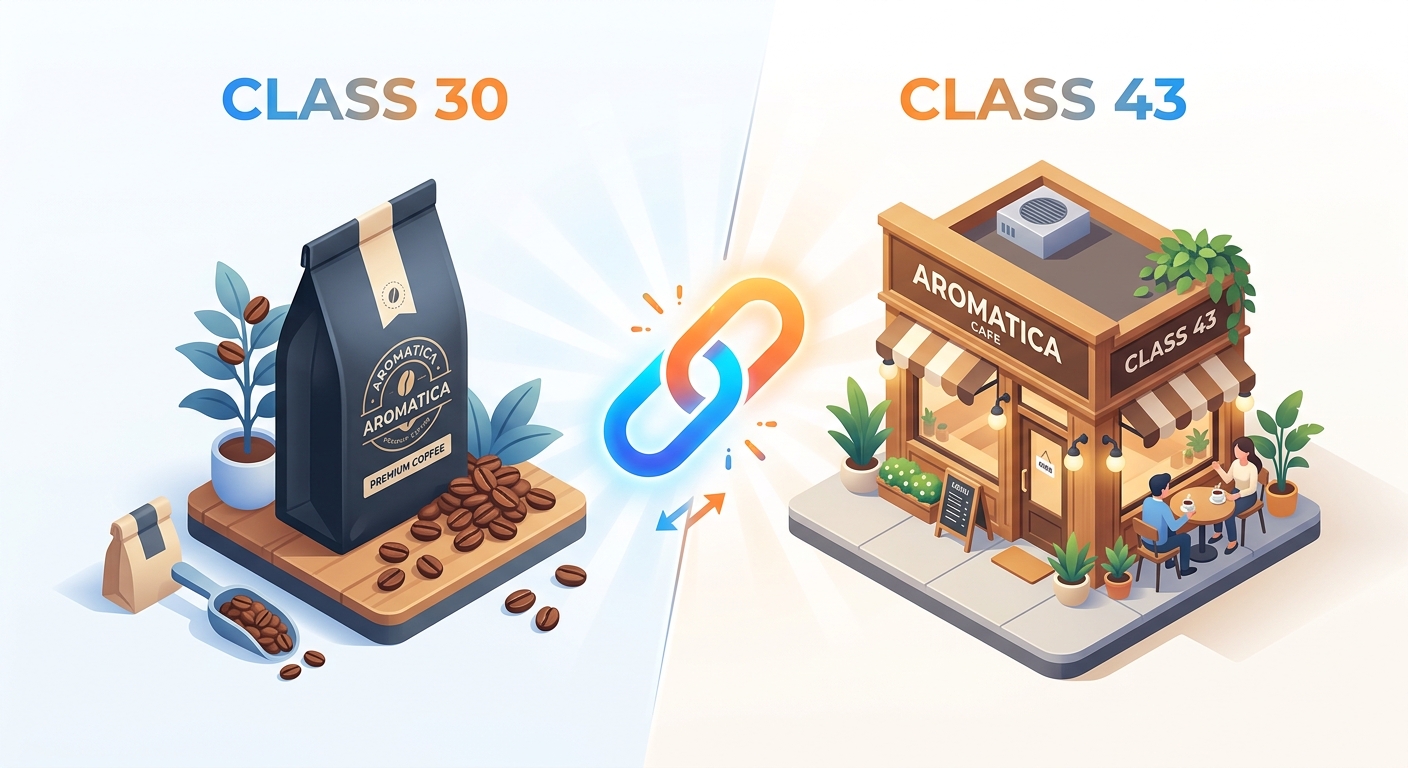
In the HoReCa sector, the International Classification of Goods and Services (Nice Classification) often becomes a battlefield due to so-called cross-cutting or related groups. The most common mistake is to believe that registering a name for a coffee shop automatically protects the same name for coffee beans, or vice versa.
The conflict usually arises between goods of Class 30 (coffee, tea, confectionery) and services of Class 43 (providing food and drink, i.e., restaurants). If someone else has already registered a similar name for coffee beans, you may be refused the opening of an establishment with the same name, as consumers may mistakenly believe your coffee shop belongs to the same product manufacturer. This is the very “likelihood of confusion” mentioned earlier.
Food brand owners should consider the following key classes:
- Class 29 — meat products, dairy, frozen convenience foods;
- Class 30 — coffee, tea, bakery, and confectionery products;
- Class 32 — non-alcoholic beverages, beer, juices;
- Class 33 — alcoholic beverages (except beer);
- Class 43 — restaurant services, catering, venue booking.
Such segmentation requires a strategic vision from the restaurateur: do you plan to sell your own sauces under this brand in supermarkets (Class 29/30), or will you limit yourself only to serving dishes in the dining hall (Class 43). Even if you are launching a technological solution for restaurant automation, the specifics of name registration in the western region require taking these cross-interests into account to avoid blocking the project’s development in adjacent niches.
However, the boundaries of the gastronomic business today go far beyond the plate, forcing owners to think about protecting assets that seem secondary at the start.
Merchandise and Franchise Protection: What Lviv Restaurateurs Often Forget
When a Lviv pub or conceptual coffee shop becomes part of a tourist route, the brand inevitably extends beyond the kitchen. However, most entrepreneurs make a critical mistake: they believe that protecting the name within food services is enough to safely sell souvenirs or launch a chain. In practice, professional trademark registration must cover the Nice classes responsible for commercial capitalization and scaling.
For Lviv’s gastronomic sector, where merchandise (T-shirts, mugs, bags) is a significant source of income, the standard Class 43 (restaurants) is not enough. If you plan to sell branded items or grant the right to use the brand to other partners, you should pay attention to the following protection structure:
| Business Goal | Nice Class | What exactly is protected |
|---|---|---|
| Selling own merchandise | 21, 25 | Branded tableware, glasses, hoodies, caps, and tote bags. |
| Launching a franchise | 35 | Business management assistance, advertising, organization of retail networks. |
| Own craft products | 29, 30 | Sauces, jams, pastries, or semi-finished products under the establishment’s name. |
| Packaging and delivery | 16 | Unique design of paper packaging, menus, and printed materials. |
Interestingly, such solutions often have a souvenir-oriented bias, unlike cities like Dnipro or Kharkiv, where businesses more often focus on industrial or service classes. This creates specific competition in the tourist goods segment, where the establishment’s name becomes the product brand.
For those preparing a project for scaling through franchising, Class 35 is a legal “must-have.” Without it, a commercial concession agreement may be declared invalid regarding the transfer of brand management rights. This is the foundation that allows for the safe replication of a successful Lviv model in other regions without fear of legal pushback from competitors.
Note: This material is for informational purposes only. The choice of classes depends on your business model and the results of a preliminary search. To build a protection strategy, it is recommended to seek a professional legal assessment.
Name Verification Algorithm Before Starting a Project in Lviv
When starting a new gastronomic project, it is important to follow a clear sequence for brand verification. Next, we will analyze the advantages of expert analysis and the specifics of forming a budget for the legal security of your business.
Expert Opinion: Why a Lawyer Sees More Than an Algorithm
Automated search services often create an illusion of security by only showing exact name matches. However, during the qualifying examination at the IP Office (UKRNOIVI), specialists look not just for identical words, but for similarity to the point of confusion. This is a subjective concept that an algorithm cannot evaluate: phonetic similarity (how it sounds), visual similarity of logos, and semantic meaning that could confuse your establishment’s guests.
An experienced lawyer analyzes not only the registries but also the history of refusals from recent years, understanding where an office expert might see a risk. For example, a name might be deemed descriptive for a certain group of goods or misleading regarding the manufacturer. An expert opinion helps identify these pitfalls even before filing the application, which significantly reduces the likelihood of receiving a provisional refusal and losing state fees. Such an analysis provides the business owner with an understanding of real chances for success and allows for timely naming corrections without unnecessary risks.
The next stage after a high-quality analysis is the budget calculation, where it is important to understand the structure of state fees and the actual timelines for document processing.
Timeline and Costs: How Much a Business Owner’s Peace of Mind Costs

Now that we have understood why a lawyer’s professional eye sees risks much deeper than any automated software, let’s move on to the pragmatics that interest food project owners the most: budget and time. Successful brand registration in the western region requires an understanding that state fees are not a tax on thin air, but a payment for the legal filter your name passes through at the UANIPIO (Ukrainian National Office for Intellectual Property and Innovations).
The cost of the procedure directly depends on the number of Nice Classification classes and whether the logo contains color. For restaurants and food producers, it is critically important to budget for several classes simultaneously to protect not only the menu name but also a future franchise or line of sauces. Below is a basic calculation of official fees, provided the application is filed electronically (which is 20% cheaper than the paper format).
| Expense Item | Estimated Amount (UAH) | Comment |
|---|---|---|
| Application filing fee (1 class) | 4000 | Base fee for one list of goods or services |
| Additional fee for each subsequent class | 4000 | If you register the name for both a coffee shop and coffee roasting |
| Color inclusion fee | 1000 | Paid if you submit a color image of the logo |
| Registration publication fee | 600 | Per Nice class after successful examination |
| State duty for certificate issuance | 85 | Final payment to receive the protection document |
Regarding timelines, business owners should be patient. As of today, there is no expedited trademark registration procedure in Ukraine—all applications are considered on a first-come, first-served basis. The process usually goes through the following stages:
- Search and Filing (1–5 days): Conducting a check and securing the priority date at UANIPIO.
- Formal Examination (2–3 months): Verifying the correctness of the documents and payment of fees.
- Substantive Examination (12–18 months): The most important stage, where originality and the absence of conflicts with competitors are checked.
- Registration and Issuance of Certificate (1–2 months): Publication in the official bulletin and receiving the paper certificate.
Investing in a business owner’s peace of mind through proper trademark registration in Lviv pays off the moment competitors first attempt to copy your concept. However, sometimes even a perfectly prepared application encounters resistance from the market, which we will discuss in detail below.
Real Cases: How Playing with Similar Names Ends
In the Lviv gastronomic industry, legal theory quickly turns into a fierce struggle for recognition, where real cases of confrontation between brands reveal all the pitfalls and risks of opposition from competitors.
Opposition Risk: How Competitors Can Block Your Registration
Even if the chosen name has passed an internal check, there remains a critical stage where competitors gain a legal mechanism to stop your expansion. Opposition risk is a procedure during which any third party can file a reasoned objection against the registration of your mark. According to Article 10 of the Law of Ukraine “On the Protection of Rights to Marks for Goods and Services,” such an objection is filed within three months after the publication of the application in the official bulletin.
For food brands in Lviv, this stage is the most risky due to the high density of the HoReCa market. Large chains and national leaders often use automatic monitoring services for new applications to react instantly to the appearance of similar names even before the examination is completed.
Typical Similarity Factors That Cause Opposition
How to Assess Blocking Risk: A Checklist for the Owner
- Check for “Aggressive” Rightsholders: Are there companies in your niche (for example, craft beer or confectionery) that actively litigate over similar names?
- Cross-Class Analysis: Are there trademarks in adjacent Nice classes (e.g., 29 and 30) that might consider your name a threat to their brand?
- Regional Identity Test: Using words like “Lviv,” “Galician,” or the names of historical districts of the city can trigger opposition from brands that already have a monopoly on these geographical indications.
One of our clients, the owner of a local pastry shop, faced opposition from a large national holding. Although the brands operated in different price segments, the opponent proved that a similar graphic element in the logo created an association with their sub-brand line. To avoid such costly conflicts, professional registration should include a strategic risk assessment even at the naming stage.
Disclaimer: This material is for informational purposes only. The assessment of opposition risk depends on the specific mark and current UANIPIO practice. Individual legal consultation is recommended for decision-making.
Your Brand Deserves to Be Unique and Protected
Your business in Lviv is not just a spot on the gastronomic map, but a reputational asset that requires a reliable legal shield. Timely registration allows you to transform a creative name into a legal asset that can be valued, contributed to the authorized capital, or transferred under a franchise agreement. According to the Law of Ukraine “On the Protection of Rights to Marks for Goods and Services”, priority is given to the first to file an application; therefore, delay in the highly competitive Lviv market is a critical risk.
Strategic Matrix for Regional Brands
For food projects planning to expand beyond the Western region, it is important to consider the specifics of national registration:
Remember that investing in legal clarity at the start saves hundreds of thousands of hryvnias on future rebranding and legal disputes. As your project scales, the trademark certificate itself will become your primary argument in negotiations with investors and partners.
Disclaimer: This article is for informational purposes only. To assess the chances of registering a specific designation and to minimize the risks of opposition, it is recommended to order a full legal search of the databases of registered trademarks and filed applications at the SE “UkrNOIPI”.
If you need help with this task, use the Trademark Registration service.
Frequently Asked Questions
Can the protection of a Lviv trademark be extended to foreign markets if export is planned?
Yes, after filing a national application in Ukraine, you gain the right to use the Madrid System for the International Registration of Marks. This allows you to file a single application through the UANIPIO, specifying the list of countries where you plan to implement your food project (for example, EU countries, the USA, or Canada).
Key advantages of this approach include:
- payment of a single set of fees instead of separate payments in each country;
- no need to involve local patent attorneys in each jurisdiction at the filing stage;
- the possibility of gradually expanding the list of countries in the future based on an existing international registration.
It is important to remember the “central attack” rule: during the first 5 years, an international registration depends on the fate of the basic Ukrainian application or certificate.
What is the link between trademark registration and obtaining a .UA domain name?
For many food brands focused on online ordering and delivery, having a prestigious top-level domain .UA is critical. According to domain delegation rules, only owners of registered trademarks can obtain a name in this zone.
It is essential that your TM name completely matches the chosen domain. In this context, TM registration solves two tasks at once:
- Legal protection of the establishment or product name from copying.
- Technical capability to secure a short and recognizable website address in Ukraine’s national zone.
At the application stage, it is worth checking if the corresponding domain is available to avoid conflicts with “cybersquatters” in the future.
What to do if a similar trademark is already registered but not actually used by the owner?
Ukrainian legislation includes a provision stating that any interested party may apply to a court for the early termination of a TM certificate if it has not been used by the owner without valid reasons continuously for the last five years.
This mechanism is often used to “clear the path” for new brands when:
- the old mark is “dormant” and not represented on the market;
- the TM owner has ceased business activities;
- the TM was registered solely to obstruct competitors (bad faith registration).
Before initiating such a process, lawyers conduct a thorough collection of evidence regarding the absence of products or services under this mark in circulation.
Can changes be made to the logo or name after the registration application has already been filed?
Legislation allows only minor corrections that do not change the essence of the designation. For example, you can update the applicant’s address or correct an obvious typo. However, it is impossible to fundamentally change the font, add a new graphic element, or change part of a word in the name.
If, during the brand development process, you decide to rebrand and significantly change the logo, the only correct solution is to file a new application. This is why we recommend conducting the final legal search only when the visual concept of the brand has been fully approved by the owner.
Why is it necessary to monitor new applications after you have already received a trademark certificate?
Obtaining a certificate is only the beginning of protection. It is important to understand that the IP office examination may not always identify all potentially similar designations filed later. The Trademark Watching service allows a business owner to:
- timely detect competitor applications that are confusingly similar to your brand;
- submit reasoned objections (oppositions) within the established 3-month period after the publication of someone else’s application;
- block the registration of “clones” even before they obtain official rights.
Preemptive protection is always cheaper and more effective than subsequent legal disputes over the cancellation of already issued certificates.
How to properly arrange the transfer of trademark use rights to partners when launching a franchise network?
If your Lviv food project scales through a franchise, the use of the trademark by partners must occur based on a license agreement. This document clearly defines:
- the scope of the rights transferred (territory, term, list of goods/services);
- the amount and procedure for paying royalties (remuneration for using the brand);
- quality requirements for products that the partner produces under your TM.
Registering such an agreement in the state register is not mandatory, but it is recommended as it serves as official confirmation of the licensee’s rights before third parties, banks, or customs authorities.